
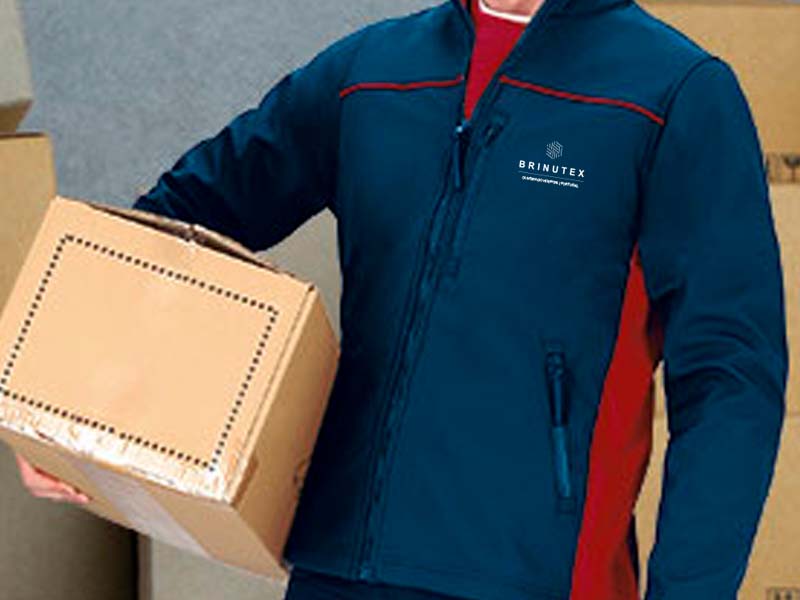
Renewing a company's image and clothing is a strategic decision combining HR management, corporate identity and operational efficiency. In healthcare, catering, industry, logistics or services, choosing new uniforms directly affects everyday employee comfort and customers' perception of quality.
Yet decisions often focus on appearance or initial unit price, overlooking technical factors that determine durability and long-term return on investment.
For a smooth, effective transition, we have gathered the key factors to assess before ordering your organisation's new branded workwear.
1. Fabric Weight and Density: The Right Balance
One of the most important workwear specifications is fabric weight, measured in grams per square metre (g/m²), which indicates the fabric's density.
The wrong weight can mean garments that are too hot and stiff in summer, or thin, fragile fabrics that tear after a few months of intensive use.
| Fabric weight | Garment type | Recommended application |
|---|---|---|
| 140–180 g/m² | T-shirts / polo shirts | Summer, base layers |
| 190–230 g/m² | Premium polo shirts / coats | Customer service, healthcare, clinical use |
| 240–300+ g/m² | Trousers / jackets | Industry, construction, logistics |
Spring/Summer Garments (140–180 g/m²): They offer coolness and freedom of movement, but require well-constructed knit fabric to retain their shape after washing.
Everyday Corporate Garments (190–230 g/m²): Ideal for polo shirts, tunics and coats. They offer opacity, good drape and a structured appearance.
Heavy-Duty Garments (240 g/m² or More): Suitable for multi-pocket trousers, operational jackets and protective clothing, where abrasion and tensile resistance are priorities.
2. Easy Washing and Daily Care
Workwear faces more demanding conditions than everyday clothing. Depending on the sector, uniforms undergo frequent washing and contact with grease, disinfectants or industrial dust.
When choosing your company's uniforms, assess fibre composition:
- Easy-Iron Treatment: Balanced polyester-cotton blends dry faster and require virtually no ironing, simplifying employees' routines.
- Dimensional Stability and Colour Retention: Check for pre-shrinking or sanforising treatments. Poor-quality fabrics lose corporate colour vibrancy after a few washes, making uniforms look worn.
- Washing Temperature: In healthcare and food-related sectors, clothing should withstand high-temperature hygienic washing without damaging the garment or customisation.
3. Fast, Flexible Stock Replenishment
A major uniform-management problem can arise months after the first order, when new staff join or damaged garments need replacing.
Relying entirely on distant imports can mean months of waiting for small replenishment orders or, at worst, discontinuation of the chosen style.
When planning uniform renewal, make sure your supplier offers:
- Style Continuity: The garment range and corporate colours should remain available in the catalogue over the long term.
- Small-Quantity Replenishment: The ability to order additional units for new employees without high minimum quantities.
- Local Production: Portuguese garment production and customisation significantly reduce response times and simplify stock management.
4. Customisation Techniques: Embroidery or Printing
A company logo turns an ordinary garment into customised workwear and a brand communication tool. Choosing embroidery, screen printing or DTF depends on the fabric and garment use.
| Technique | When to choose it |
|---|---|
| Embroidery | Polo shirts, shirts, jackets, coats and aprons. For high durability and an elegant raised finish. Resistant to intensive washing. |
| Screen printing / DTF | Fine-knit T-shirts and high-visibility clothing. Logos with multiple shades or gradients. Large print areas, such as the back. |
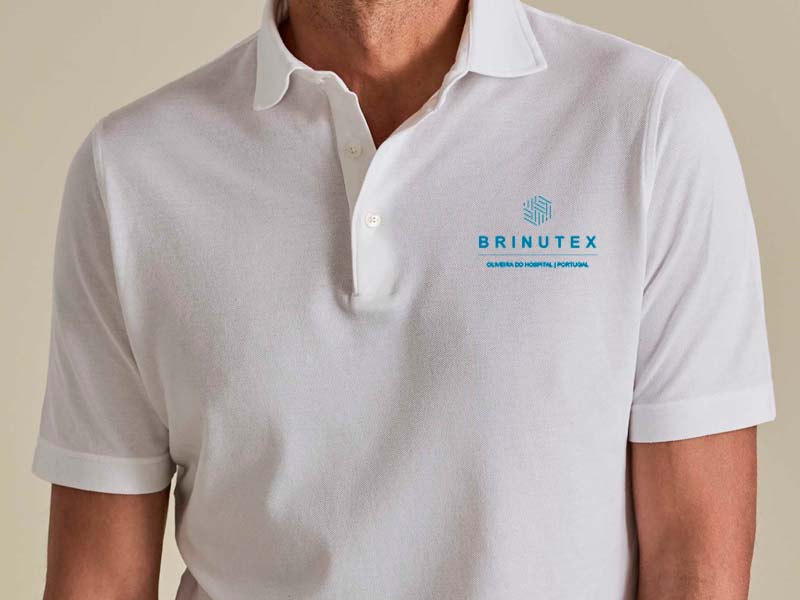
Computerised Embroidery: It is the most refined and durable option. Its elegant three-dimensional finish is highly resistant to frequent washing. It suits corporate polo shirts, shirts, clinical tunics, jackets and aprons.
Screen Printing and DTF (Digital Printing): Recommended for lighter fabrics such as 140 g/m² T-shirts, where embroidery would be too heavy. DTF reproduces complex, multicoloured logos and small details in high definition.
5. Team Involvement and Anthropometry
A common purchasing mistake is choosing sizes from generic estimates — S, M, L, XL — or ordering only unisex fits.
To ensure clothing fits every employee:
- Offer Men's and Women's Fits: Anatomical proportions differ. Fits adapted to the female body avoid garments that are too long or broad across the shoulders, supporting comfort and workplace safety.
- Provide Size Samples: Before finalising the order, arrange a fitting with physical samples. This significantly reduces exchanges after delivery.
Practical Checklist Before Placing the Order
Before approving uniform renewal, check these essentials:
Specialist Support for Your Business
Corporate uniform renewal does not need to be complex. Technical support, from material selection to customisation, turns the investment into durability, comfort and team pride.
At Brinutex, we help organisations develop and source business uniforms and branded workwear, with sector-specific solutions, personal support and responsive replenishment.
If you would like our help to define your team's new workwear range, contact the Brinutex specialists and receive a free proposal tailored to your business requirements.

Comments
Comments are published after approval by Brinutex.
Write a comment